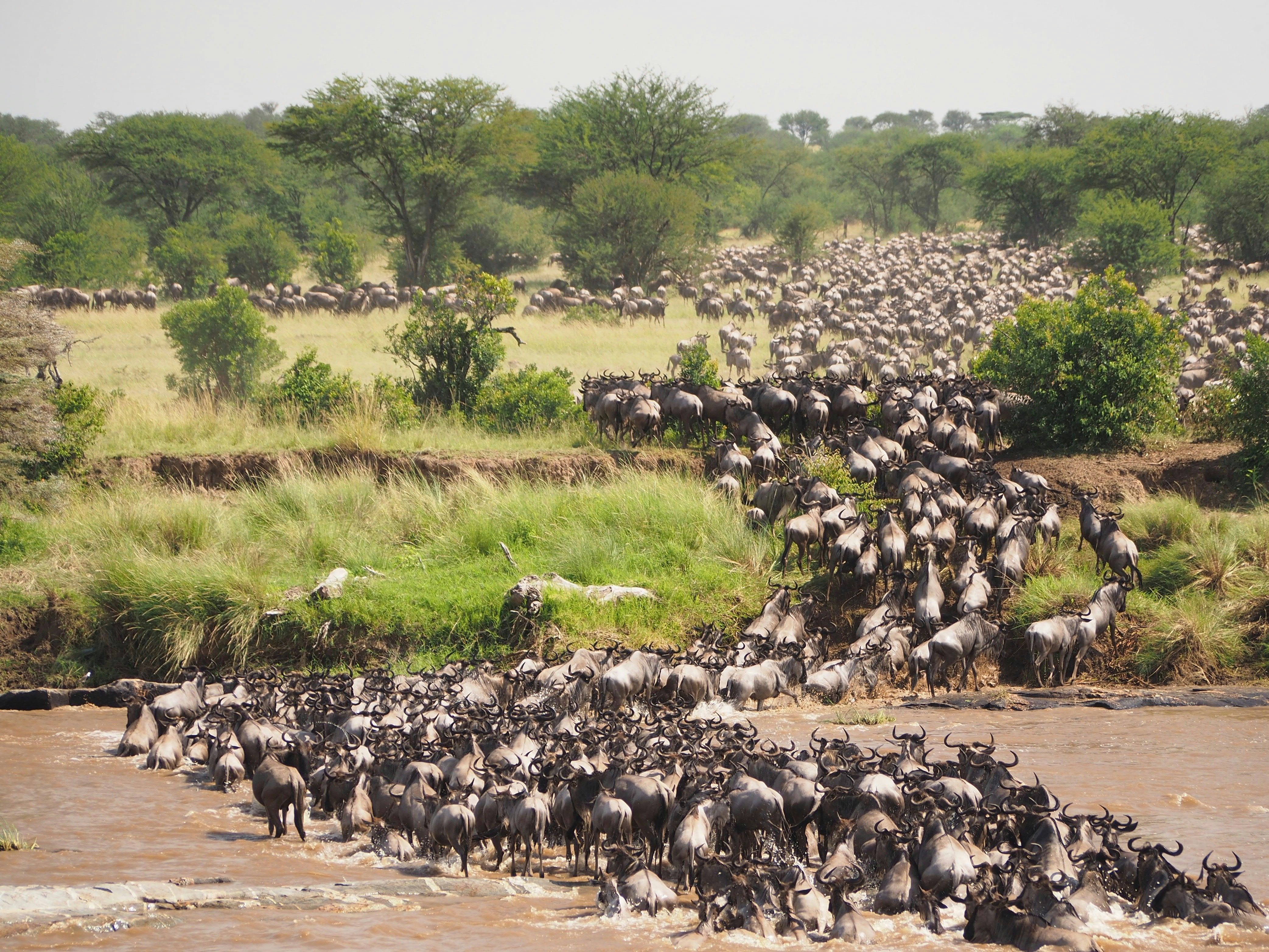
Great Migration: What Guests Should Understand
The Migration is not a single event — it is a year-round movement. Where to be in July is not where to be in February. Timing the camp choice is everything.
The Great Migration is one of the most-asked-about wildlife events on earth, and one of the most misunderstood. It is not a single event. It does not happen at a fixed location. And what guests should plan for varies significantly depending on what they actually want to see.
What the migration is.
Roughly 1.5 to 2 million wildebeest, plus zebra and gazelle, move in a year-round circuit through the Serengeti ecosystem and the adjacent Masai Mara. The animals follow rainfall and grass growth. The circuit takes a calendar year.
Where the herds are, when.
December through March: the southern Serengeti and Ndutu region of northern Tanzania, where calving happens. April and May: the central Serengeti. June through October: the western Serengeti corridor and the Masai Mara in Kenya, including the famous river crossings of the Mara River. November: the herds begin moving south again.
What guests usually want.
The image most clients have in mind is the river crossing — wildebeest plunging into the Mara River while crocodiles wait. This happens July through September, sometimes into October. If this is what the client wants, the timing and the location both need to be deliberate.
What we tell clients planning for a river crossing.
The crossings are unpredictable in timing. A herd may sit on the riverbank for hours before moving, or not cross at all that day. Planning four or five days in the Mara during the crossing window gives the best chance. Three days is too tight.
What the calving season offers.
February in the Ndutu region of Tanzania is, in our view, one of the most underrated migration experiences. The herds are dense, the predator activity is intense (calves attract lions and cheetahs), and the camps in this area are less booked-out than the high-season Mara properties.
Where we usually base clients.
For July–October river crossings: Mara North Conservancy or the Mara Triangle in Kenya, sometimes paired with the northern Serengeti. For calving season: the Ndutu region of Tanzania.
The point we make most often.
The migration is not the only reason to go on safari. A non-migration safari in the right location and with the right guides can equal or exceed a migration safari for wildlife encounters. Building the trip around the migration is a specific decision, not a default.
Let us help you think through it.
We work through these conversations carefully, one journey at a time.
Start Planning